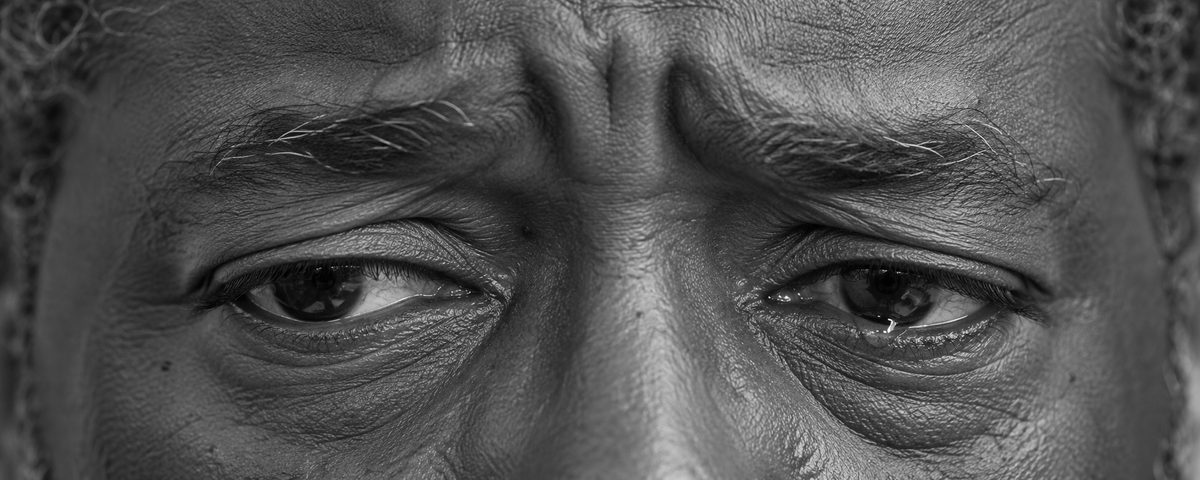
Which word best describes what this person is thinking or feeling?
- upsetRight answerWhen something has gone wrong and you feel sad or hurt about it.
- sleepyWhen you feel tired and ready to fall asleep.
- shyWhen you feel unsure around other people and would rather not be noticed.
- scaredWhen you feel afraid that something bad is about to happen.
How the photographs were made
Each face started as a few sentences describing a person and a feeling, and an image model turned the sentences into a photograph.
The description
Every description has four parts. The first is the same for all of them; the person, the feeling and the light change each time.
- The look
- A black and white photograph, tightly cropped to the eye region of one adult: from just above the eyebrows to just below the lower eyelids. Both eyes fully visible, the bridge of the nose visible, no mouth, no hair except where it meets the forehead. Landscape framing, 5:2 width to height. Candid documentary photography, like a crop from a magazine portrait: real skin texture, pores and fine lines, natural light, slight film grain, no retouching, no stylised makeup, no illustration or 3D render look, no text, no border, no watermark. The gaze and the small movements of brows, lids and the muscles around the eyes must carry the mental state on their own, since nothing else of the face is shown. Keep the expression subtle, as caught in a real moment, never acted or exaggerated.
- The person
- A Black man, about 55, grey at the temples.
- The feeling
- Brows drawn together and lifted at the inner ends, eyes slightly glassy, gaze a little downward. Hurt rather than angry.
- The light
- Soft window light from one side.
From a description to one photograph
- The people
- Twenty women and twenty men, aged 18 to 75, five from each of eight backgrounds; the test shows 20 of them. Two wear glasses, and each has a small detail of their own, so no two faces are alike.
- The feelings
- Each is written as brows, lids and gaze, like the one above. Eighteen people look straight at you and twenty-two look away, spread evenly across pleasant, unpleasant and neutral feelings.
- Three lights
- Every face was made three times, in window light, in flat daylight and in warm lamp light.
- The model
- OpenAI's GPT Image made every photograph from its description.
- Picking one
- First we threw out anything wrong: a mouth, text, colour, an eye that looked off, a gaze that gave the feeling away. Of the rest we kept the one whose brows and lids matched the description most quietly.
- Second tries
- Three feelings came out as something else. Ashamed looked exhausted, proud looked grateful, relieved looked sad. We rewrote their descriptions and made them again.
The words
Forty feelings, one per photograph, and each also appears as a wrong answer somewhere else. The three wrong answers on a photograph share its tone, pleasant, unpleasant or neutral. They are words a ten-year-old knows, each with a one-line meaning in both languages, and in Spanish every word agrees with the person in the photograph.
amused · ashamed · bored · calm · confident · confused · curious · daydreaming · defiant · disappointed · doubtful · excited · exhausted · fed up · flirting · focused · frustrated · grateful · guilty · hopeful · hostile · hurt · impressed · insisting · interested · jealous · mocking · nervous · playful · proud · reassuring · relieved · remembering · surprised · suspicious · tender · thoughtful · waiting · watchful · worried
Which photographs stay
A photograph stays in the test when at least half of the people who answer it choose the word it was made for and no other word draws more than a quarter. The original Reading the Mind in the Eyes test used the same rule to go from 40 photographs to 36.
Stays
Dropped
Fading in five steps
Every photograph also exists in five versions, the feeling fainter in each one, for a version of the test that finds the faintest feeling a person can still read.